Awareness
- Familiar experiences
- Notice where attention goes
- Competing demands
- Notice shifts and omissions
- Unfamiliar settings
- Recognize patterns across settings
Current work
The research priority is to develop a competency framework that can inform a developmental pathway across K–12. A middle school proof of concept is the preferred first application.
Research in development
What must a person know, notice, understand, and be able to do to work skillfully with attention?
The framework is the foundational research output. A source-supported brief, one learning prototype, and a plan for a later pilot support its development and examination.
01 / Current work
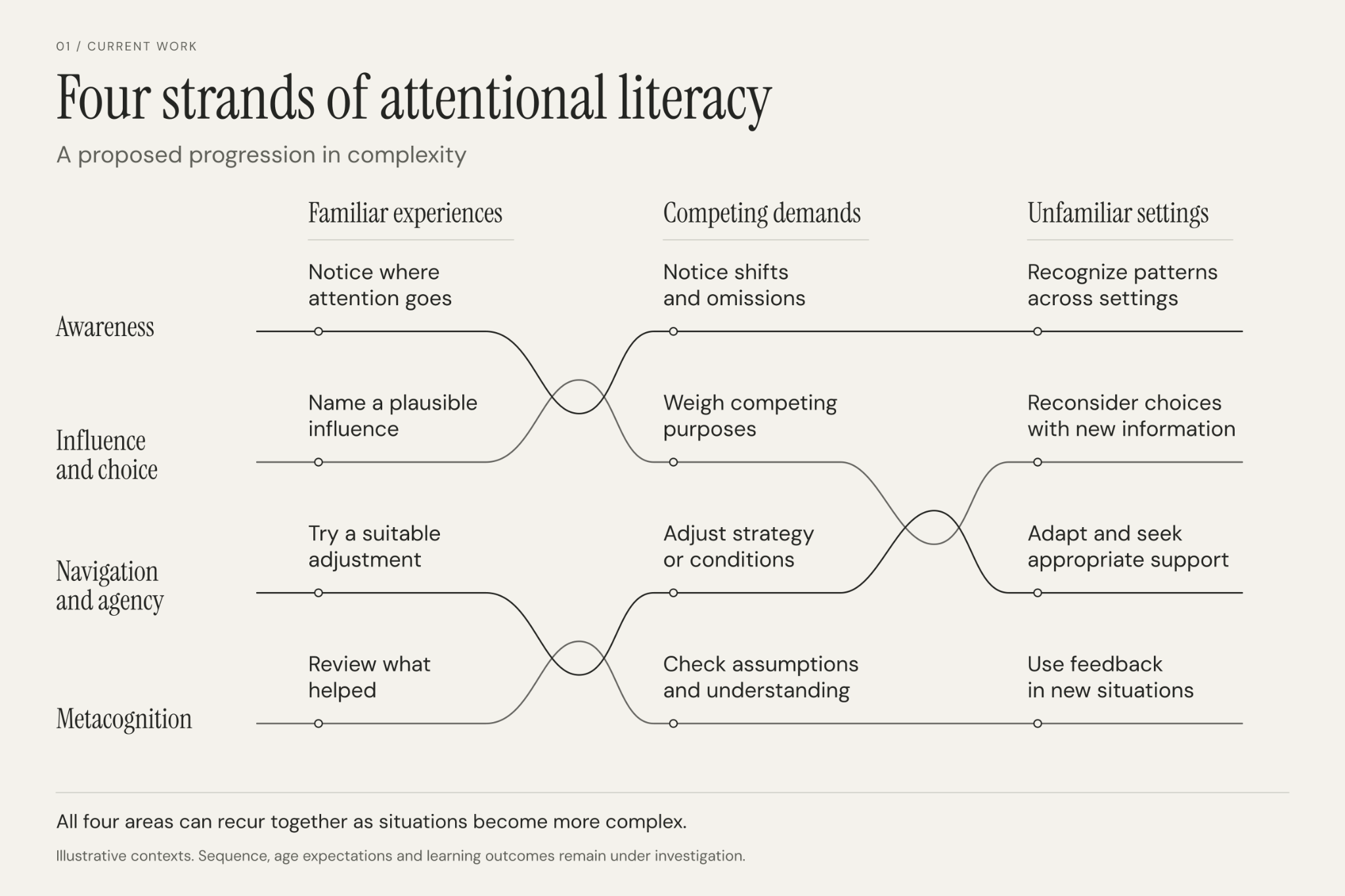
A proposed progression in complexity
The longer-term aim is to describe how attentional literacy could develop across schooling. Questions for each setting help frame that work:
These are planning questions. The research needs to determine which competencies belong at each stage, how to account for different learners and supports, and what a useful progression would look like in practice.
The preferred proof of concept would work with middle school students, initially through an afterschool program. One substantial prototype would provide a way to examine the language, learning activities, and proposed progression before considering broader applications.
Afterschool settings may offer a more practical route to initial development and delivery than adoption within the school-day curriculum. A lower barrier to entry is a planning assumption to explore with potential hosts.
The age group and setting are strategic starting choices. A host, delivery arrangements, participation process, and reviewed learning plan would need to be agreed before a later pilot. No host or pilot is confirmed, and a youth program is not open for enrollment through this site.
A later pilot would help refine the competency framework and learning progression. Questions include:
Evidence about feasibility, learning, and use in other settings needs an appropriate evaluation design. An immediate activity or positive response would not establish lasting learning or program effectiveness.
Phase One
A proposed account of relevant knowledge and abilities, including personal and relational attention, to inform a K–12 developmental pathway.
The brief will examine the concept, its intellectual sources, and the rationale for the proposed competencies.
One learning and practice prototype would show how selected competencies might be taught, with an afterschool setting as the preferred initial context.
The actual group and host would help shape the learning tasks, pace, and supports. Phase One prepares the prototype. Youth delivery and participant data collection would belong to a later agreed pilot.
A plan for how a later proof of concept could test and refine the framework and developmental progression.
Ways to contribute
Relevant literature, conceptual critique, or specialist expertise in attention, contemplative sources, education, and learning development.
Conversations with middle school educators and youth-serving organizations about learning needs, feasibility, and a possible later proof of concept.
Discussion of resources for research, specialist review, prototype design, and evaluation planning.
Share relevant expertise or a possible educational connection. The first step is a conversation about fit and scope.
Get in touch